Can you play pickleball after a hip replacement?
Returning to pickleball after a hip replacement requires more than simply feeling good or being able to walk without pain. The hip needs adequate healing time along with progressive strength, stability, neuromuscular control, and the ability to tolerate the specific movements and loads involved in pickleball.
Rehab can help rebuild single-leg strength, lateral movement, balance, reaction, and control before progressing from light court drills to more unpredictable play. Post-Surgical Performance Care can help bridge the gap between being medically cleared and being physically prepared to return to the court.
A gradual progression allows you to evaluate how the hip responds during and after activity before increasing the intensity, duration, and unpredictability of pickleball.
4 min Read
This is a fairly common question among the pickleball community.
My answer is “Of course!” But just make sure you do your rehab. And No, at 3 weeks you are not ready.
Surprisingly many of the doctors in my area (so I’m told) don’t actually prescribe a full course of rehab after hip replacements which is absolutely baffling to me. Most patients are told that walking will be enough. I understand that the anterior procedure doesn’t cut the muscle but just opening up the body, cutting something out and putting something new in is traumatic and the body needs to adjust and learn it’s new parts….that is part of rehab
So if you are looking to get back to activities, walking really isn’t enough even with the anterior procedure
How Long Does It Take to Heal After a Hip Replacement?
In the past we have discussed healing time for different tissues as you see below.
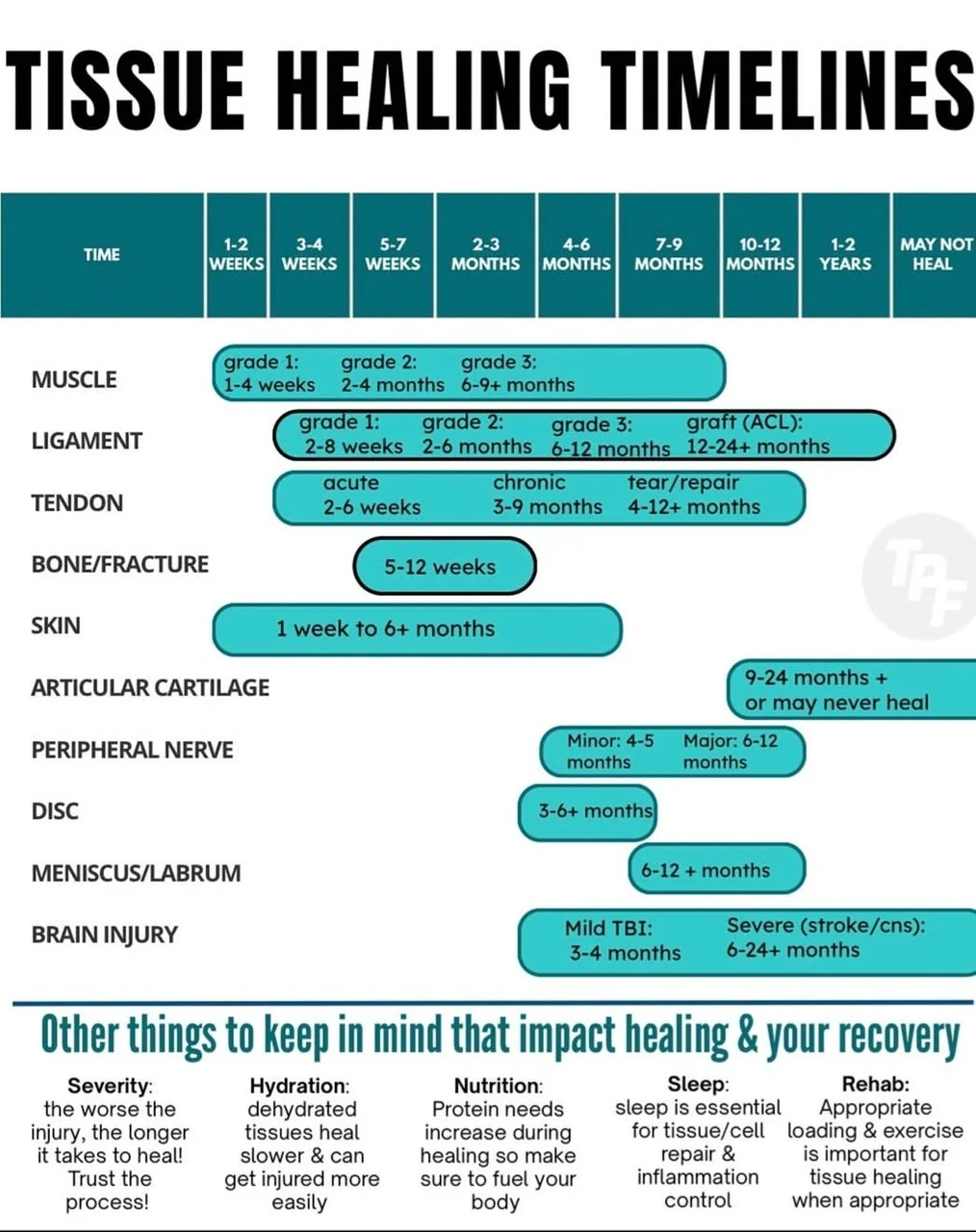
Bone takes 6-8 weeks to heal. You just literally had part of a bone cut off and a new part inserted in it’s place. As well as a new surface applied to your pelvis where they are planning on the bone growing around it to hold it in place.
This is why feeling good at 3 or 4 weeks doesn't mean the hip is completely healed. The early weeks after surgery are still an important healing period, and with an uncemented implant, the bone is continuing to grow onto and integrate with the new hardware over time.
This doesn’t mean that you can’t be doing rehab during this time….you absolutely should be, but in controlled settings and movements so not to disturb the process of the bone healing. So no cutting or twisting as you have to during pickleball play.
I know one person who had a hip replacement and decided to start playing again around 3 weeks post surgery. Said he was feeling great so went back to play 2 hours a day 3 times a week.
After about 2 weeks of doing this he ended up taking the next 3 months off in order to reduce his pain and swelling that had occurred during those 2 weeks.
If he had followed a good rehab program and waited the initial 8 weeks to start playing again he wouldn’t have lost as much time as he did, being out almost 6 months total before being able to play at the level he was before. He is a strong guy and on the younger side so bone healing and strength were on his side for healing timeline. He just got too ambitious and set himself back.
So let’s not make these same mistakes!
When Is It Safe to Play Pickleball After a Hip Replacement?
Besides giving the tissues the proper time to heal….when is it safe to return to play?
Your hip will need to be able to handle the loads applied to it during play. So single leg sit to stands and side lunges are an essential part of the rehab progression. Being able to load the single leg while playing is a must.
As well as stability on that leg, this isn’t just being able to balance on it. This begins with core strength and stability, so definitely something that can be worked on while the hip is healing.
Why Neuromuscular Control Matters After Hip Replacement
Neuromuscular control. Even if you had an Anterior procedure where there is minimal soft tissue being disrupted or cut during the surgery, the body still experiences some fairly traumatic events. Again literally the head of the femur being cut off and a new implement being inserted. The brain perceives this and goes into protection mode. (If you haven’t read my blog about the Heirarchy of Protection go read it now) This is the idea that when the brain/body has an event, it will then try to protect that area. So making the brain feel safe again and making sure the neuromuscular control is maintained is one of the most important reasons to do rehab after a hip replacement.
Being medically cleared by your doctor and being prepared to return to activities are two completely different things.
How Do You Know If You're Ready to Return to Pickleball?
If you can:
Walk briskly without pain, swelling, or a limp
Perform a controlled single-leg sit-to-stand
Lunge forward and laterally with good control
Move side-to-side and decelerate without guarding
Rotate through the trunk and hips without compensating
Then you can start to do some light dinking and kitchen drills. Nothing where you are going to have to react quickly turn or pivot. Just light movement to get you back on the court for short periods of time…..this will also help build up some endurance as you are getting closer to increasing drill and eventually return to play.
As you continue to get stronger, can balance and react on the surgical leg, and can tolerate progressively faster movements without symptoms during or after, then you can start adding more live drills. From there you can gradually increase the intensity, duration and unpredictability of your drills until you are ready to start adding games.
Remember, there is a big difference between being able to dink at the kitchen for 15 minutes and playing three games where you have to react, change direction and move for balls you weren't expecting!
Ready to Get Back on the Pickleball Court?
If you are ready to bridge the gap between my surgeon said I am cleared to ACTUALLY being prepared to play let me help you get there. Check out my Post-Surgerical Performance Care. This is where we work to get you back onto the court.
Or schedule your Initial Assessment below.