Why Am I Still Stiff Months After Surgery? The Missing Piece Most Rehab Programs Never Address
Many people expect surgery to completely resolve their symptoms, yet months later they still experience stiffness, swelling, or movement limitations. This article explains the difference between tissue healing and true recovery, and why feeling "healed" does not always mean your body has fully returned to normal function.
The article explores how residual swelling, protective movement patterns, and nervous system responses can continue to limit mobility long after tissues have repaired. It also highlights the importance of restoring range of motion, retraining movement, and addressing factors that may be overlooked during post-surgical rehabilitation.
For individuals struggling to regain full function, post-surgical rehabilitation may require more than simply waiting for tissues to heal. Recovery is complete when the body no longer feels the need to protect the area and can confidently return to normal activities.

7 min Read
This is by far the most common questions/comments I get from people who had surgery months ago but still feel stiff or swollen or just not right still.
“I thought surgery was suppose to fix everything”
Surgery Fixed the Structure. So Why Do You Still Feel Stiff?
Here is the thing, the surgeon did his/her job. Cleaned up the arthritis. Reconnected the ligament or tendon. Put the new hardware in/on the joint. And 99.9% of the time they did it well with no complications.
So why do you still not feel “normal”?
Well the body is doing IT’S job.
There is a LOT that goes into this. So let’s start with healing and recovery. These are actually separate things.
Healing and Recovery Are Not the Same Thing
Healing is the biological process of restoring health in the body. So physically repairing of the tissues.
Recovery is the functional process of restoring normal state to the body, Now that the tissue is restored, range of motion and strength need to be returned.
I’ve shared this chart in a previous blog How To Recover From An Injury In Redondo Beach What To Do Who To See And What To Expect
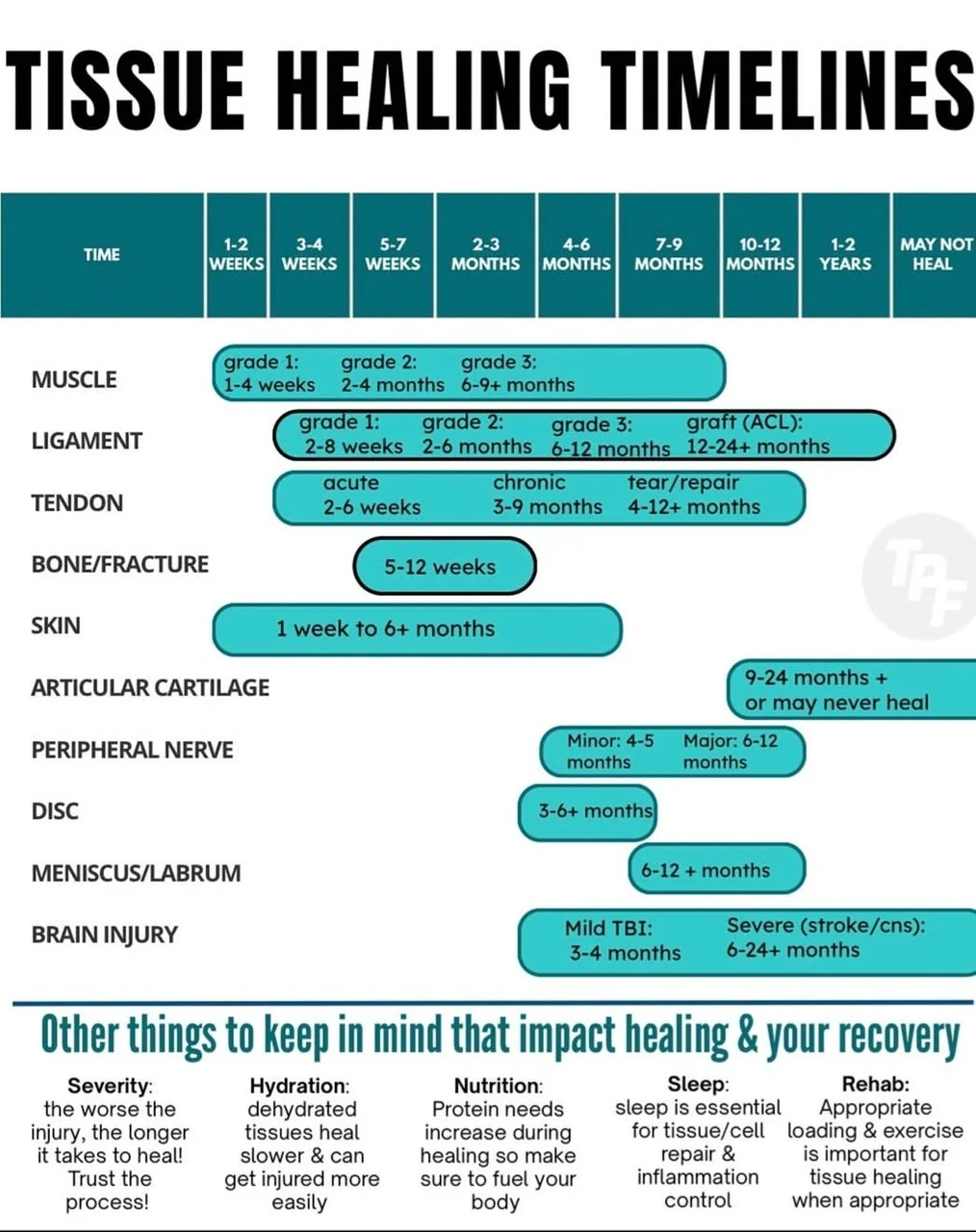
These are the time frames that it takes for the different musculoskeletal tissues to heal (different organs have different time frames as well)
This is the time it takes the body to rebuild new tissue. But think of this new tissue as a blob of tendon or muscle or skin….it’s really a scar. Now it's our job to get that blob to act like the rest of the tissue….this is the recovery part.
During this whole process things like nutrition and sleep are super important because your food gives the body the building blocks for healing so sitting around eating crap isn’t helping the cause. And during sleep is the most regenerative time of day for your body, so want to make sure that is on point as well!
Why Traditional Rehab Sometimes Stops Too Soon
You went to Physical Therapy to facilitate your recovery. Great! You likely have a bit of residual swelling. You probably have 80-90% of your previous Range of Motion (ROM) back and similar 80-90% strength from before the injury. And once you got there the Therapist discharged you. But did you ever do any of the things that would get you back to playing pickleball? Tennis? Golf? Swimming? Running? These all have very specific movement demands that need to be retrained as well. And if you only have 80% of your ROM you likely aren’t ready to go back to those activities either.
So what is keeping you from getting that last bit of ROM back?
Maybe this sounds familiar…
You are six months out of surgery. The surgeon says everything looks great. Physical therapy is complete. The swelling is mostly gone. Strength is pretty good.
But you still can't kneel down to work in the garden. You still feel stiff when getting out of a chair. You want to get back to pickleball but your body just doesn't feel ready.
But your best friend was back on the court after only 3 months!
You are frustrated because everyone keeps telling you that you should be fine by now.
And technically you ARE healed.
But healing and recovery are not the same thing.
Your Body Is Still Protecting You
Your body is incredibly smart. It knows how to heal itself. It has a hierarchy of protection that it is governed by. (I wrote a blog on that as well….Hierarchy of Protection) Most times in conventional physical therapy this hierarchy is not taken into consideration during recovery.
The Hidden Role of Swelling in Recovery
First, residual swelling. Even the most minimal amounts of swelling can affect the ROM of the joint. Just 10ml of fluid in the knee joint inhibits the quads from firing properly. So making sure swelling is gone is one of the most important things in recovery. It definitely has a purpose during the healing phase. We actually want the inflammatory process to do it’s job and bring the good nutrients in and clear the bad damaged tissue out. This is why the use of ice and anti inflammatories can slow the healing process down, they inhibit this process. But after the initial acute stages of healing, swelling can also inhibit the healing process, so managing that is imperative throughout the healing and recovery process.
There are some very specific places throughout your body that can help move the swelling out when they are addressed. The lymphatic system is a huge part of healing and recovery and if it isn’t working great, it makes this process harder. So addressing this is a huge part of the plan.
Does Your Brain and Body Feel Safe?
Next, is the brain/body. Does it feel safe? The nervous system is truly what is in control. If it doesn’t feel safe it will stay in a protection pattern.
When the body has a traumatic experience it is likely that it is holding on to some protection patterns. It can be either from the initial injury, if you had surgery or something during the process that it “didn’t like”
This may show up as tightness, pain, ROM restriction. This needs to be addressed for your recovery to be complete.
This is where the LTAP comes in. This is an assessment tool that I have learned to use. It allows me to listen to your body to find what is being protected so we can address that first to allow you to make the most progress possible in each session. (You can learn more about how I use this in my practice HERE)
To be able to return to activities your brain/body needs to feel and SHOW that it is capable of handling the forces and movements that it will need to return to full activity. These need to be tested during your recovery phase when everything is nearing 100%
Think about it this way.
If you sprain your ankle badly, your body doesn't just heal the ligament. It also creates a strategy to protect that ankle while it heals. You limp. You shift your weight to the other side (may even use crutches) Certain muscles tighten. Certain movements get avoided.
According to our chart earlier it takes anywhere from 2 weeks to 12 months for ligaments to heal. So let’s say this was a grade 2 sprain, so 2-4 months for healing of that ligament.
Even after the tissue has healed, your brain may still be operating from an old instruction manual that says:
"Protect this area."
The problem is that protection and performance are not the same thing.
Protection creates stiffness.
Protection creates muscle guarding.
Protection limits range of motion.
Protection changes movement patterns.
And if that protection is never turned off, you can be left feeling stiff, weak, swollen, or simply "not right" long after the tissue itself has healed.
Why Two People Can Have Very Different Recoveries
This is why two people can have the exact same injury and have very different recoveries. The tissue healing may be identical, but the nervous system response can be completely different.
The goal of recovery isn't simply to heal the tissue.
The goal is to convince the brain/body that the area is safe again.
What Does Making the Body Feel Safe Actually Look Like?
Restoring normal swelling management and lymphatic flow
Addressing protective muscle guarding patterns
Restoring full range of motion
Gradually exposing the body to increasingly demanding movements
Demonstrating that the joint can tolerate load, speed, and rotation again
And lastly returning to play….
Returning to Activity Is Different Than Being Pain-Free
Returning to activity isn't about being pain free.
It's about proving to the brain and body that you can tolerate the demands of the activity.
A pickleball player needs to stop, start, rotate, lunge, and react.
A golfer needs to rotate and transfer force.
A runner needs to absorb thousands of impacts.
If these movement demands are never retrained, the body may continue to protect itself even when the tissue has healed.
If you are months out from your initial injury or even surgery and still feel stiff, swollen, tight, or like you're not quite back to yourself, it doesn't necessarily mean something is wrong.
In many cases, the tissue has healed exactly as expected.
The Missing Piece in Post-Surgical Recovery
The missing piece is helping the brain/body let go of the protection patterns that were necessary during healing but are now limiting recovery.
Recovery isn't finished when the incision heals.
Recovery isn't finished when physical therapy ends.
Recovery is finished when you can confidently return to the activities you love and your body no longer feels the need to protect itself every step of the way.
If you've been told everything looks good but you still don't feel normal, I'd be happy to help you figure out what's being protected and what may be holding your recovery back. Click below and schedule your Initial Assessment.