How to Recover From an Injury in Redondo Beach: What to Do, Who to See, and What to Expect
Recovering from an injury involves understanding the type of injury, knowing when to seek medical attention, and supporting the body's natural healing process. This article explains common injuries, recovery timelines, and practical steps to improve outcomes.
The article highlights the importance of proper sleep, nutrition, hydration, and progressive movement while avoiding common mistakes that can delay healing. It also explains why pain relief does not always mean tissue recovery is complete.
For individuals navigating recovery, Athletic Training services can help identify the injury, determine appropriate next steps, and guide rehabilitation back to activity.
8 min read
One minute you're playing pickleball, gardening, working out, or simply getting out of bed...
The next minute something doesn't feel right.
Your knee pops.
Your back locks up.
Your ankle rolls.
And suddenly you're asking yourself:
How bad is this?
Do I need an X-ray?
Should I see a doctor?
How long is this going to take to heal?
The good news is this:
Recovery from injury is possible.
The human body is remarkably good at healing when given the right environment and the right plan. The challenge is knowing what to do immediately after an injury and who to see for help.
It is easy to spiral quickly when an injury occurs.
Here's the thing,almost everybody spirals after an injury. I've done it, my clients do it, and you're probably doing it right now. That's okay. The spiral usually comes from not knowing what you're dealing with. So let's fix that.
First, let’s get some common terms defined here.
Sprain: stretching and damage to a ligament (the soft tissue that connect bones together) There are degrees of sprains, minor damage (a few fibers torn) to complete tears.
Strain: stretching and damage to muscle or tendons (the soft tissue that connects muscles to bones) Again there are degrees, minor damage (a few fibers torn) to complete tears.
You can also strain or stretch a Nerve
Fracture: Broken bone. There are several types of fractures….all mean broken. And broken is broken, not partially broken.
Cartilage Damage:
Meniscus Tear: Disc of spongy tissue between your femur and tibia in the Knee
(Arthiritis is articular cartilage damage and is discussed in my blog Arthritis Is It Just Inflammation
Dislocation: Bones completely out of position. Think fingers pointing in the wrong direction or shoulders out of place. Usually some degree of ligament damage, and possible other soft tissue depending on the joint
Subluxation: Bones are partially out of position. Usually some degree of ligament damage, and possible other soft tissue depending on the joint
What to do when you first get injured.
For years, RICE (Rest, Ice, Compression, Elevation) was considered the gold standard for acute injury management. More recently, injury experts have shifted away from prolonged rest and excessive icing because inflammation plays an important role in the healing process.
Ice may help reduce pain in the short term, but it doesn't necessarily speed recovery and may even interfere with some of the body's natural healing mechanisms.
When you injure yourself an inflammatory process begins. There are several chemical and mechanical processes that begin to help stop further damage to the area and then clean up the damaged tissue and bring in new cells to help start to rebuild.
So taking and anti-inflammatory and using ice prevents these things from happening.
When Should You Go To The ER Or Urgent Care?
Since there are so many types of injuries it is hard to determine which ones need what type of attention.
Go to nearest ER or Urgent care if:
Obvious deformity
Injuries with open wounds (bones poking through skin)
Cuts that bleeding can’t be controlled.
Sharp, shooting or stabbing pain
Excessive swelling immediately after injury.
Inability to bear weight
Loss of sensation or numbness
Head injury with confusion, dizziness, or loss of consciousness
How Can A Certified Athletic Trainer Help?
If everything appears to be in place, this is actually what Certified Athletic Trainers are educated to do, evaluation of acute and chronic injury is one of the core roles of an Athletic Trainer. So visiting your local Athletic Trainer (I am located in Redondo Beach) is my first suggestion. (You can learn more about my Acute Care Package here)
Once you see your Athletic Trainer they can determine the type of injury and what the next course of action needs to be. Do you need more imaging and/or need to see a doctor? An Athletic trainer can get you going in the right direction.
They can also help determine what activities are safe to continue, what movements should be modified, and what steps you can begin taking immediately to support recovery.
If the injury is not that severe, your athletic trainer can also bring you through the rehab process and get you back feeling better and moving better again. (See Athlete Rehab Care)
How Long Does It Take an Injury to Heal? And fully recovery from an injury?
Now here is the thing, for acute injuries there are some relatively standard timelines for tissue healing
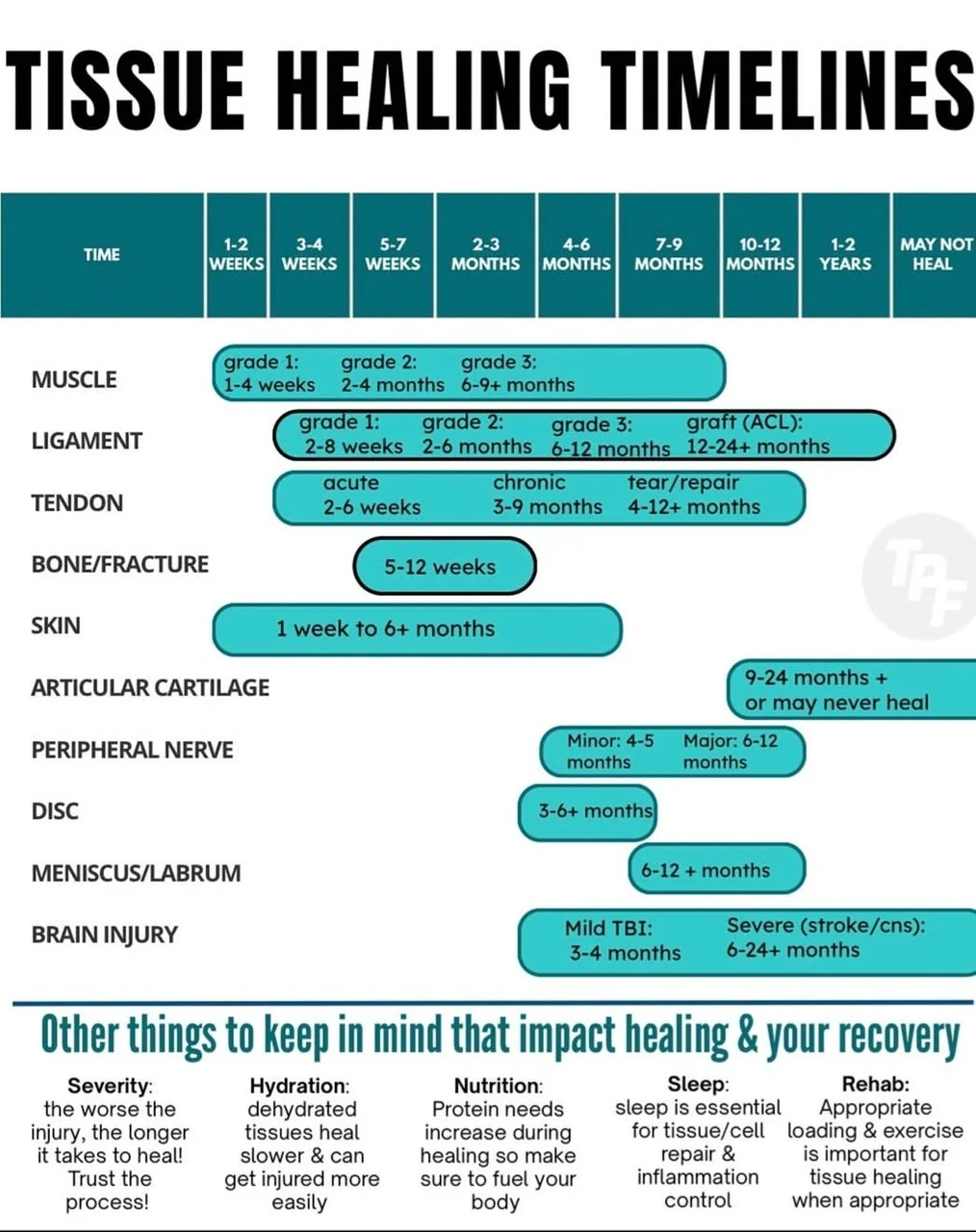
Is there variability in this? Yes.
Are there modalities that can change these timelines? Minimally. I have not seen ANYTHING that can make a bone heal faster than the typical 6-8 weeks (this is back to structural strength)
I take that back, when I worked at CHLA these kids would have fractures that healed in 3-4 weeks (not to structural strength but enough new bone had been laid down) I asked how this was possible and could we bottle it? The Dr answered “they have a ton of growth hormone in their systems. And no….apparently it’s illegal to sell it” Lol!
Unfortunately as we age we don’t make as much growth hormone.
So again, we have to let the body do it’s job. It is actually REALLY good at it when we allow it to!
What we need to do is set it up for success!
Proper sleep. Most of our healing is done while we are sleeping. This can be hard though when we are in pain. But finding comfortable positions to allow periods of sleep is essential. Using KTape can help with swelling and pain for many. An occasional Tylenol (if your system can tolerate. When I worked in the university setting I used to be a pill pusher, that is no longer the case. The less medication the better in my opinion but sometimes it is just not possible!)
Proper Nutrition. This one is overlooked a LOT! But this is what gives your body the fuel to rebuild and recover. Hydration is a huge part of this as well. Hydrated tissue moves/glides optimally. When it is dried up it is harder to move and heal!
But what I want to point out particularly about the above chart is that these are timelines for tissue to reach their original strength. This is different to when things “feel better”
Too often people return to activities once the pain is gone but the tissues are still in a very vulnerable state. This can lead to re-injury.
If we waited for the ligaments of a sprained ankle to reach their original strength we could be waiting well over a year! What we need to do is to strengthen the rest of the tissues around the joint to keep it protected so you can resume activity with minimal risk of reinjury as it continues to heal toward optimal strength again.
Common Mistakes That Slow Injury Recovery
Unfortunately, many people unintentionally delay their recovery by doing the wrong things early on. Some of the most common mistakes I see include:
Resting Too Long
A short period of rest can be helpful initially, but complete rest for extended periods often leads to stiffness, weakness, and slower recovery. Most injuries benefit from appropriate movement very early on….soon than many think.
Returning Too Soon
Just because something feels better doesn't mean it has fully healed. Pain often decreases before tissue has regained its normal strength, which can increase the risk of re-injury.
Comparing their recovery to someone else.
This I actually see quite a bit of! “Sally came back from her knee replacement and is playing pickleball after only 3 weeks! I’m 3 months and still can’t play”
This gets dangerous, As we discussed above there are relatively definite timelines. Other things needed to take into consideration are age, general health, genetics, environment, stress and mental state.
Injuries can be very hard on us socially, emotionally and mentally. If our activity that an injury is keeping you from can be very isolating and can take a toll. Also identity can sometimes be reframed during injury. Thoughts of “I’m broken” and such can change how our body heals.
So mental state and self talk are super important when working through injuries.
Not Assessing Neural and Visceral Components
This gets missed….a LOT! But mostly because most practitioners don’t even know where or how to look! And up until 6 years ago, neither did I, but once I learned, there was no looking back this is the most important part of an assessment and then treatment. It has completely changed the way I approach my clients and rehabs.
Let's say you're playing tennis. You plant your foot, twist, and injure your knee. You start rehab and are doing all the right exercises, but progress feels slow. Your knee still feels stiff. The muscles around it always seem tight. Maybe now your hip or low back is starting to bother you as well.
Most people assume the problem is simply a lack of stretching or mobility. But sometimes the body is doing exactly what it was designed to do: protect itself.
When the brain perceives a threat, whether from the injury itself or from other factors affecting the body, it can increase muscle tension, limit movement, and create protective patterns that make recovery more difficult.
This is where the LTAP assessment comes in. LTAP is a tool I use to help determine what your body may still be protecting and where we need to start. Before we focus on improving strength or mobility, we first want to help the brain and body feel safe enough to allow movement to occur.
If the body is still in protection mode, you can spend hours stretching your hamstrings or performing knee exercises and still struggle to regain full range of motion. Addressing the underlying protective pattern helps the body move more freely and allows the rehabilitation process to progress more effectively.
Proper Rehab Matters More Than Most People Realize
This is exactly what i do as an ATC in my Athlete Rehab Sports Injury Prevention service!
Having a carefully and individually designed program that addresses specifically your pain, restrictions and strength needs are essential in working your way through an injury and back to activity.
Not only are we working on the structural damage that has occurred but I also take into consideration the neural and visceral pieces that play a part in injury and recovery. (if you haven’t read my Blog Hierarchy of Protection check that out now) These are usually more of the driver on chronic pain issues. What is the body still protecting? It may have started as an acute injury, but the body is still in protection mode and that needs to be addressed before the area of pain is.
This is especially common with low back pain.
According to my mentor Anna Hartman almost all SI joint pain has a visceral connection to it. So just treating the area of pain is not enough. The entire person needs to be addressed. I also believe that rehab starts immediately. Waiting and resting only prolongs recovery. There are things that we can start directly to the area (aside from direct fracture areas) to start improving swelling and pain. As well as continuing to work on the rest of the body. Keeping up with strength of the rest of your body is shown to help increase strength at an injured area. So stopping training all together is usually not the best road to recovery.
Some other modalities that may also help with the recovery process are Acupuncture. My favorite in the South Bay is hands down Karen Liu at HealSpace. Absolutely phenomenal! Massage therapy. The therapists at VIVE in El Segundo are great! They also have Red Light Therapy which can help at the cellular level of healing.
Injuries are frustrating.
They interrupt your routine, affect your confidence, and often create more questions than answers.
But your body is designed to heal.
Understanding what type of injury you're dealing with, supporting your body's healing process, avoiding common mistakes, and following a well-designed rehab plan can make a tremendous difference in how quickly and successfully you recover.
Recovery may not always be linear, but progress is possible.
Need Help Recovering From an Injury in Redondo Beach?
If you've recently been injured and aren't sure what to do next, I help active adults and athletes throughout Redondo Beach and the South Bay determine what's really going on and create a plan for recovery.
Whether you're dealing with:
Ankle sprains
Knee injuries
Low back pain
Shoulder injuries
Sports injuries
Pickleball injuries
My Initial Assessment is designed to identify what your body is protecting, determine what factors may be slowing recovery, and help you get moving in the right direction.