The 3 Best Chest Opener Exercises
Spending long hours sitting at a computer, driving, or looking down at a phone can gradually pull the body into a rounded posture. Over time this position can create tension through the chest, neck, and shoulders while limiting breathing capacity and upper body mobility.
Restoring chest mobility and improving posture often requires more than just stretching tight muscles. Addressing deeper structures, encouraging spinal extension, and restoring normal movement patterns can help the body feel safe enough to release protective tension.
Techniques such as soft tissue work around the neck, thoracic extension exercises, and hanging movements can help reopen the chest, reduce compression in the spine, and improve breathing mechanics. During a rehab performance session, these strategies are often combined to help restore healthier posture and reduce upper body discomfort.
4 min Read
OK so if you have read any of the past few blogs I talk a lot about the Hierarchy of Protection and addressing the viscera first, particularly with upper extremity pain. If you haven’t, go read “hierarchy of protection” and “what is visceral manipulation” to catch yourself up!
Why are these topics so important? If our body is in a protection pattern then it will do everything to stay in that protection until it feels it is safe and no longer needs to protect. So you can stretch all you want but are likely not going to gain much ground….at least in the long term.
Now what are some ways to open up your chest and why is that important?
If you find yourself sitting hunched at a computer for hours on end day after day, chances are you need to open up your chest. Our world is set up for us to be sitting with rounded shoulders and head looking forward/down. Sitting at the computer, driving the car, looking at your phone, watching TV…..these are all the same basic position and with that much time spent in that position we are starting to stay in those positions
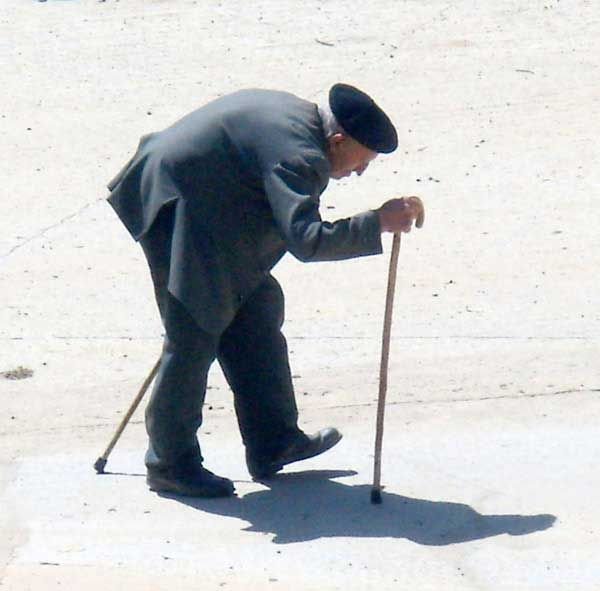
No one wants to end up like this!
This is what I would start with….
First, using a Yoga Tune Up Ball I'd do a release of some of the deep neck structures. HERE is how I do this. Everything from the suspensory ligament of the lung to the 1st rib and deep muscles around the neck are affected with this one thing! This allows your insides to feel safe and allow for your chest to open up from there!
Next and by far my favorite way to start countering this hunched over position is to do the opposite. Now the trouble with this is that most of the muscles in the back get stretched out in the hunched over position and tend to be weak because of this and actively extending the back gets harder and harder, so using a foam roller to help is my go to! Check out the video HERE. For many this is very challenging and can be a bit uncomfortable. But after just a few days the response is usually something like “It doesn’t feel great while I’m doing it, but I feel great after I’m done”
Or “I feel like I can breath better after doing this” Or “ I can now take a deep breath” It’s super hard to expand your lungs and get a deep breath in when you are folder forward over your lungs.
Then I do some Hanging. Particularly when getting into extension is hard, trying to restore and keep an upright position is next best! So by hanging on a bar we start to work on getting back our true upright alignment. If you are not comfortable completely having your feet off the ground no problem! Just holding onto the bar and unweighting yourself will A. Build grip strength (this is important and will be discussed in a future blog) B. Allow gravity to start helping you straighten out. If you don’t have access to a bar, you can use a door frame, a tree branch, or even use a strap behind the door.
This is a great exercise for so many reasons!
First, by hanging you start to reduce the compressive forces of gravity while having your feet on the ground. When you are hanging or unloaded with feet on the ground, gravity then pulls on you from your arms, elongating you and opening the spaces between your vertebrae, and thus restoring the proper curves of your spine.
Second,it begins to open up your chest, by stretching the pecs and front of your shoulders as your arms go straight over your head. It alsot stretches out the sides of your body again creating more space around your lungs and allowing for better breathing.
Third, begins to work on increasing your grip strength. Grip strength has been closely related to mortality rates, the stronger your grip strength the longer you live! So at first you may not be able to hold yourself on the bar for very long….just starting with sets of 1 deep breath (3-5 seconds) and working up to 5-10 deep breaths. (Side note, I tend to do things by breaths instead of times for a couple reasons. 1. Most people tend to hold their breath while doing exercises and while there is a time and place for a breath hold….it is NOT during a duration of an exercise. 2. Unless you have a wall mounted clock that you can accurately track time on….most people “counting” seconds is too variable)
A bonus thing I would do is a Clavicle Scrub. Again this can sometimes be very uncomfortable for some.
But there are 6 muscles that attach directly to the clavicle and can influence the function of the shoulder, rib cage athey are are not chronically tight is crucial!nd neck….so ensuring

When chest, shoulder, or neck tension keeps coming back, it’s usually a sign the body is protecting something deeper.
Stretching and mobility drills like this chest opener can absolutely help, but if the tightness keeps returning, it’s worth looking at the bigger picture.
In my 90-minute movement assessment, I look at how your joints, nervous system, and internal systems are working together to determine why your body may be stuck in a protective pattern.
If you live in the South Bay and want to finally understand why your pain or tightness keeps coming back, you can learn more about my approach HERE
What’s Next on Your Reading List
Want to understand why your chest and shoulders get tight in the first place?
Many people think tight chest muscles are just a posture issue, but in many cases the body is protecting something deeper.
To understand how the brain creates protective tension patterns throughout the body, read my article on how the body prioritizes protection when something feels unsafe.
1 Hierarchy of Protection: A Truly Holistic Way to Treat the Body
Sometimes posture and shoulder tension can even be influenced by the organs and nervous system.
2 What Is Visceral Manipulation and Can It Help With Pain?
And this same idea applies all over the body. For example, pain in the thigh when squatting is often not actually a muscle injury at all.
3 Why You Might Feel Sharp Pain in Your Thigh When Squatting