Sharp Pain in Thigh When Squatting: What It Could Be
Sharp thigh pain during squats or bending is often blamed on a muscle strain, but many cases involve irritation of the femoral nerve rather than damaged quad tissue. Because this nerve travels from the low back through the pelvis and into the leg, compression or limited nerve mobility anywhere along its path can create sharp, burning, or electric sensations in the front of the thigh.
Pain location does not always equal pain source, and organ referral, neural tension, or spinal involvement can all contribute to symptoms that feel muscular but are not. In my movement sessions and orthopedic assessments, I look at the full picture to determine whether the issue is coming from the hip, spine, nerve pathway, or a protective pattern elsewhere in the body.
Understanding the difference between true muscle strain and nerve driven pain changes how you respond, especially since aggressive stretching and foam rolling can worsen irritation. A thorough history and movement assessment helps identify what the body is protecting and where to safely begin.

8 min Read
I hear this question quite a bit.
“I get a sharp pain in my thigh when I squat or bend down. What is that?”
My first question back is “did you do anything to strain the muscle? Running, cutting, jumping, lifting anything heavy? Anything like that?”
If they answer no, then that usually rules out a true strain of the muscle.
Is It Really a Muscle Strain?
Muscle strains are a protective mechanism of the body. What usually is happening is the peripheral nerve is being stretched. It is much easier for the body to heal muscle (or bone) than nerve tissue so it will likely tear the muscle tissue first. That tension you feel in the muscle before the pain of injury, is actually the nerve being tensioned. (Read more about this idea in the blog Hierarchy of Protection)
When someone hasn’t done anything obvious to strain the muscle, and there is no tenderness or pain with resisted strength testing, it pushes us to look beyond the muscle tissue itself.
Why a Thorough History and Movement Assessment Matters
Of course I take a thorough history and then a Movement Assessment. This gives me a clearer picture of what/when the pain started and during what movements specifically give them pain.
I do specific orthopedic tests to rule out the possibilities of having a hip labral tear or impingement. Or other hip pathologies. All of these can send pain into the quad and thigh.
Could the Pain Be Coming From the Back?
I have them do movements to determine if there is a possible bulging disc in their back that could be pressing on one of these nerve roots. The most common is bending forward from the hips and getting pain in the quad. But moving into back extension can sometimes produce the same sensation so doing some other movements and test to rule this out is important.
Understanding the Femoral Nerve
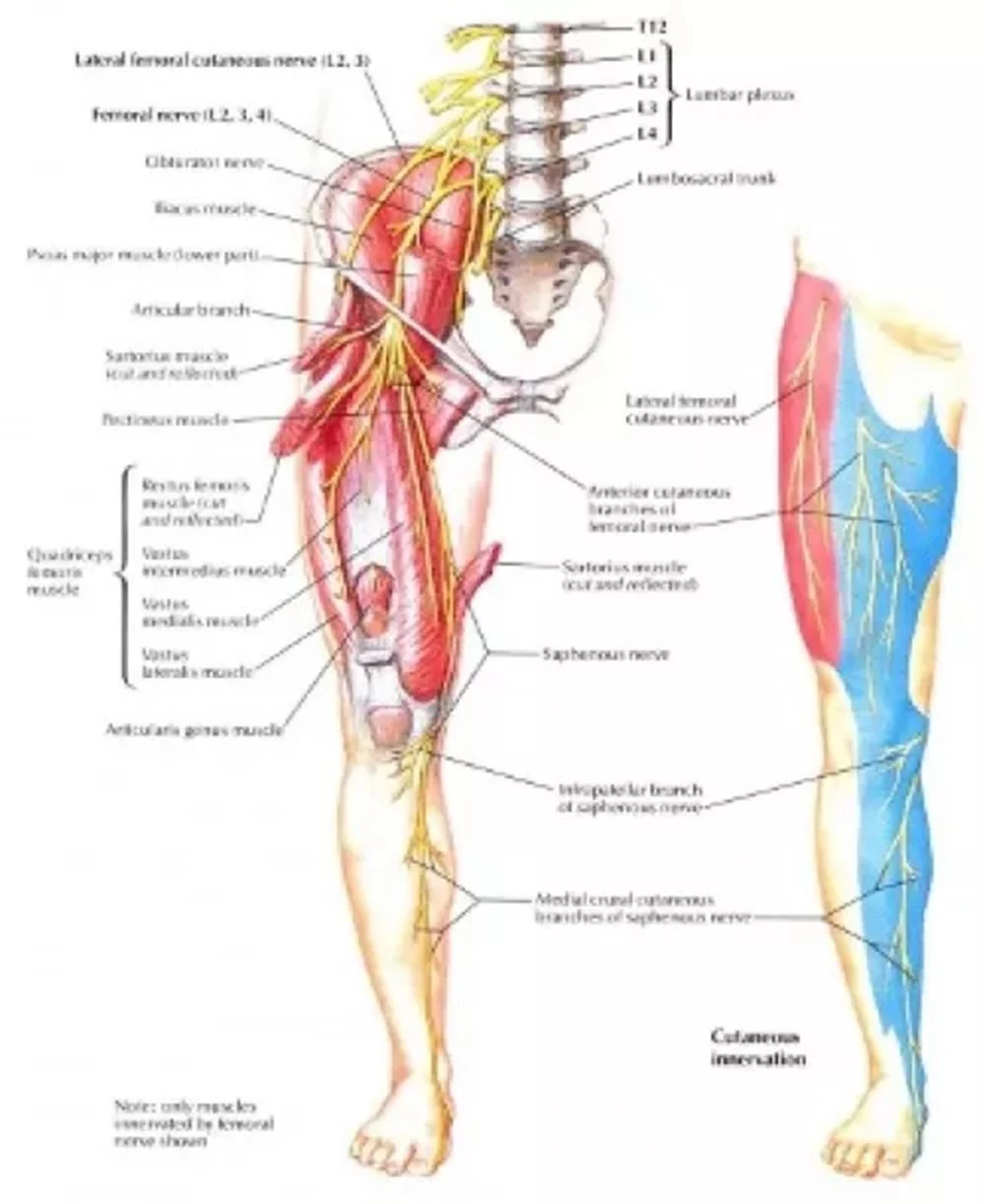
See the nerve that innervates the quad is the femoral nerve. This forms from the roots of the nerves from L2, L3 and L4. It then passes through the back of the pelvis to the front of the leg. So this sharp pain in the quad may be caused by the nerve being entrapped (pinched) somewhere above. But this nerve travels all the way down to your big toe, so anywhere along this chain can cause pain in your quad! Many times the point of pain is not the actually site of “injury” So the quad itself is actually fine….it’s simply where the nervous system is expressing the pain.
Why Squatting Brings on the Pain
So when you squat you are now possibly impinging on the femoral nerve closer to the origin of it in the back, or somewhere along its path to the big toe. And with all the joints and areas that it moves through, there are many areas that it can get “hung up” and cause pain in the quad!
The femoral nerve plays a huge role in both strength and sensation in the front of the thigh. When it’s irritated, people often describe pain as
sharp
stabbing
burning
or “zingy,”
especially during deeper squats or bending movements.
This is also why stretching the quad or foam rolling the front of the thigh often doesn’t help, and can sometimes make it worse. The issue isn’t tight muscle tissue, it’s limited nerve mobility or compression somewhere along the nerve’s pathway.
Pain Location vs. Pain Source
This is one of the biggest misunderstandings in musculoskeletal pain, the location of pain is not always the location of the problem. The body works as an integrated system. Which leads me to the next set of tests….the LTAP.
Using LTAP to Find Where the Body Wants to Start
Then I do the LTAP (Locator Test Assessment Protocol) to locate where their body wants me to start.
Now this is where it gets truly interesting. The small intestines, kidneys, bladder and reproductive organs are also innervated by these same nerves! So any of these organs can refer pain to your quad!
How Organ Referral Pain Works
Let me explain. Each organ basically has a pain referral pattern, meaning where there is a protection pattern happening at that organ, you can feel pain in a different area of your body. The best and most extreme example of this is the heart and Left shoulder. Most people are aware that if you are having shortness of breath and pain in the left shoulder, should probably head to the ER to make sure you aren’t having a cardiac episode! Most organs don’t work in such extreme scenarios.
It is more like this; each organ has its own type of movement in the body, for example the kidneys move up to 3cm each per breath! That is a lot of movement. Well what if one gets stuck, and isn’t moving as well. This could be from coughing or sneezing or falling and landing on your back….the reasons are endless. But now the body is protecting the kidney and it continues not to move well. This can be felt in the quad because the same nerve roots innervate both places!
When this happens, the nervous system may increase protection in surrounding tissues, which can show up as pain somewhere completely different, like the front of the thigh.
Again most of the time these protection patterns are NOT emergencies! They are just signals saying something isn’t right inside.
Neural Protection and the Dura
Along the same lines there can be a neural protection pattern. Hang with me here. Your muscles have a sheath around them, basically helping keep it together. (Think seran wrap) Well your brain and spinal cord have their own sheath as well called the dura. Now there can be a kink in the dura, which now when you squat doesn’t allow the nerves to glide and can cause a sharp pain anywhere down the path of the nerve.
What Not to Do If You Have Sharp Thigh Pain
If you’re experiencing sharp pain in your thigh, avoid
aggressively stretching the quad
forcing yourself deeper into squats
or foam rolling through pain.
These approaches often increase nerve irritation and prolong symptoms.
Pain that feels sharp, electric, or sudden is information, not something to push through.
My go to movement to help release an entrapped femoral nerve is this Femoral Nerve glide
What to Do Next
If this sounds like your current experience, a sharp pain in your thigh and haven’t been able to figure out what is causing it. Click the link below and set up your free discovery call. We will chat and see how I can help you!
You can also find more information about my services on my Orthopedics page