How long after a meniscus tear can you run?
A meniscus tear is a common knee injury that affects how your joint handles load, movement, and impact. This article explains what actually determines when it is safe to return to running and why symptoms matter more than imaging.
It breaks down key signs your knee is ready, when to be cautious, and how to test your tolerance before getting back on the road or trail. Guidance is based on how your body responds to movement, not just what shows up on an MRI.
If you are unsure where you stand, working with a Certified Athletic Trainer can help you safely bridge the gap between injury and running again.
6 Min Read

So you’ve been told you have a meniscus tear… but you just want to know one thing:
When can I run again?
Well, this depends a little bit
It depends on a lot of different things:
How stable is the tear?
How long ago did the injury happen?
Is there still swelling in the knee?
How much is the injury currently limiting your movement?
And most importantly… how is your knee responding to load?
Before we talk about running, let’s take a quick step back.
What Is a Meniscus Tear?
Quick anatomy lesson.
There are three main types of cartilage in your body:
Articular cartilage – the smooth cartilage on the ends of your bones that allows joints to glide without friction.
Elastic cartilage – the flexible type found in places like your outer ear.
Fibrocartilage – a tougher, spongier type that acts more like a shock absorber.
The meniscus in your knee is made of this third type: fibrocartilage.
You actually have two menisci in each knee. Their job is to help distribute force, absorb shock, and manage the shear forces that happen every time you walk, run, or change direction.
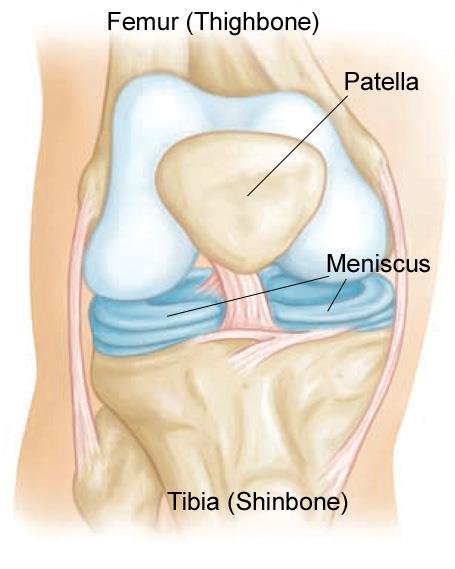
Not All Meniscus Tears Are the Same
There are several different types of meniscus tears. Some are simple, some are more complex.
Some tears have the potential to heal on their own.
Some are stable.
Some are not.
These differences matter when deciding whether it’s safe to return to activities like running.
You may have been told you have something like a “complex tear” or a “bucket-handle tear.”
But here’s the important thing most people don’t hear:
The type of tear on imaging doesn’t automatically determine whether you can run.
What matters much more is how your knee is responding.
Is it swelling after activity?
Does it feel unstable?
Does it tolerate loading and impact?
Are you able to control movement through the hip, knee, and ankle?
Because when it comes to returning to running, function matters far more than the MRI report.
Common causes of meniscus tear
Many tears happen when you plant your foot and then turn or twist your knee on that planted foot. The meniscus can get pinched and tear during that movement.
Another way is in a deep squat or knee bend. In this instance there is usually a bit of a glide of the meniscus forward and backward when you bend your knee. Sometimes this isn’t working properly and the meniscus gets caught pinched and can tear.
A similar thing can happen with hyperextension of the knee where it gets pushed backwards and can pinch the meniscus causing a tear.
Lastly there can be general deterioration over time (usually due to faulty movement pattern/protective patterns) causing wear and tear on the joint.
How Are Meniscus Tears Diagnosed?
Tears are usually diagnosed through an MRI. But again just because the picture says you have a tear doesn’t tell the whole story. What is most important is how your knee and body are responding.
Swelling
Instability
Llocking
Or barely even know it’s there!
What Actually Matters When Deciding If You Can Run
Tears That Often Do Fine With Movement:
Minimal swelling
No locking
Load-tolerant
You feel confident moving on it!
Tears That Need More Caution
Mechanical locking
Catching
Large swelling response
Giving way, Huge 🚩
If you are in this first category, you could probably start back into straight forward flat surface running fairly quickly after initial injury. As long as you don’t get increased swelling and pain post run.
If you plan on doing more dynamic running, such as trail running, sprints, anything with cutting or changing directions….you should probably start a rehab program before jumping straight back into running.
If you fall into the second category, conservative rehab is still worth trying. But in some cases, symptoms are better managed with surgical intervention.
A Quick Note on Surgical Options
There are a few options here, the quickest return option is to have a meniscectomy where the Doctor goes into your knee arthroscopically and removes the damaged tissue. This is a great minimally invasive procedure and can have you back running in just a few weeks, if your symptoms allow. The drawbacks of this is that now you are starting to take part of this shock absorber out of your knee leaving you closer to a possible bone on bone scenario. But as long as you keep up with your strength program should be able to keep running for many years to come!
There is a procedure that actually tries and stitch the meniscus back together. The healing time for this is MUCH longer! For this you need to keep your knee immobilized for a minimum of 4-6 weeks as to not disturb the area that was stitched back together. This can work if the tear is closer to the outer edge of the meniscus where there is actually blood supply and healing can occur. Tears that are deeper usually do not have great results with this type of repair.
There are new technologies coming out as far as implants, but the recoveries are much longer and these are more invasive procedures.
When is it safe to run again?
You’re likely ready to try running when:
No Swelling
No Instability
No Locking
No Pain with loading
This also doesn’t mean go out for a 20 mile right right off the bat.
Start slow and easy and test how your knee responds to a slightly slower pace and distance. (Yes I realize sometime slower causes more loading to the joint. This doesn’t need to be race pace though!)
24-48 Hour Rule
If you go out for this run and you experience any swelling in the next 24-48 hours….unfortunately you aren’t ready to run yet….even if the run itself felt fine!
A few more strength sessions to build the strength around the joint in order to keep if feeling safe and stable are needed.
That is the main role of rehab. To allow your body to feel safe again to do the activities you want to do, in this case run.
Movements I want to see BEFORE you Run!:
Reverse TKE
This one is more important than it looks. I’m not just looking at strength here—I’m looking at your ability to control your knee as it slows down. That eccentric control is crucial for running, and if it’s missing, your knee won’t feel safe with impact.
KoT Lunge
Being able to load your knee and move into a knee over toe position is essential for running.
If your body doesn’t feel safe there, it won’t feel safe when you’re out running.
Hamstring Curls
Your hamstrings are your brakes. If you’re not paying attention to them, you’re missing a huge part of your program.
They are what help you slow down and control each step when you run.
No foam roller? You can do these on an exercise ball instead.
2 Foot hops
This is where we start to see if your body is truly ready to run.
I have a colleague who won’t let people run until they can jump rope for 10 minutes straight, and I agree with that philosophy.
Running requires you to handle 3–4 times your body weight on one leg with every step.
If your body doesn’t feel safe handling that at a lower level, it’s not going to feel safe when you start running.
If you do not feel safe and comfortable doing ANY of these exercises, then you are NOT ready for running.
Running is essentially a series of controlled single-leg hops.
If your body doesn’t feel safe doing that at a low level… it won’t feel safe doing it at speed.
Final Thought
This isn’t a full return-to-run program.
This is just where I start to see if your body is even ready.
Ready to Get Back to Running?
If you’re in Redondo Beach or the South Bay and not sure where you fall…
I help people bridge this exact gap, from injury to confidently getting back to running.
Click HERE to learn more, OR
If you would like to get started now click the button below to schedule your initial assessment and let’s get you going!
Next on your reading list
Want to stay active with a meniscus tear? Can You Play Pickleball With a Torn Meniscus?
Frustrated with setbacks? Why Rehab Isn’t Linear
Not sure if you should rest or push? Rehab Is Not Just Rest