Back Stiffness after running?
8 min Read
Back stiffness after running is often a protective response rather than a sign of structural damage. The body tightens when it feels unsafe, commonly due to muscle imbalances, core instability, or even internal protective patterns that show up as low back tension.
When stiffness keeps returning, it signals that compensation is happening somewhere in the system. Addressing the root protection pattern, often through specialized work like LTAP-based assessment, can help the body feel safe again and reduce recurring tightness after runs.

Common Causes of Back Stiffness After Running
There are several possible reasons that your back gets stiff after running:
Muscle tightness/weakness
Weak core/posture
Training surface
But ultimately it ends up being a protection pattern. What about this activity made your body feel unsafe that it doesn’t want you to do it again? And what do you need to do now?
How Muscle Tightness, Weakness, and Posture Are Connected
Let’s take a look at each of these:
Muscle tightness/weakness. These two really go hand in hand. If there is tightness in the muscle it can’t contract at its maximum capacity which results in weakness. Conversely if a muscle is weak, then the muscles around it become tight due to compensation for that weak muscle.
This plays directly into the weak core/posture….if the core isn’t able to hold you in the proper position, then it places tension on a lot of other muscles, which then become tight after the run. This may also show up as pain in the hips or hamstrings. I’ve actually worked with several runners lately with this current situation.
Does Training Surface Matter?
Lastly, training surface. There is a lot of talk about training surfaces and how you shouldn’t run on hard pavement. My contention is this, the harder the surface the more stable it is, which is actually better, particularly if you are new to running.
If you have just taken up running, you haven’t built up the stability to run on softer, less stable surfaces, thus causing more pain and compensations. As boring as it is, I recommend starting on a track. It is a bit softer than pavement but stable, unlike sand or trails. In my area there is a woodchip trail which honestly I don’t like either.
Why Back Stiffness Shows Up After Your Run
So really your back stiffness AFTER your run is really just feedback that your body didn’t feel safe DURING your run.
Your body wants you to be able to do the things you ask of it, so it will find ways to work around things that don’t feel great to it, so you can continue with your activities…..until it won’t. There is only so much your body can compensate. So when it finally has had enough, it gives you pain and asks for you to change something. Again this is just your body/nervous system protecting.
Back Stiffness Does Not Automatically Mean Injury
Now this doesn’t mean you have injured anything or that there is damage anywhere. It’s just that your body doesn’t feel safe….and that needs to be address.
So really all three of the above possibilities all actually the same….they make your body feel unsafe.
Why Stretching Alone Usually Doesn’t Fix the Problem
So what should you do?
Commonly you are given a series of stretches, which do sometimes help during the moment, but don’t usually stick. You feel like you constantly need to keep stretching to not feel stiff after your run and beyond.
What you actually need to do is make your brain and body feel safe again.
Nervous System and Visceral Protection: A Missing Piece
How do you do that? Great question because first you need to find out what it is that your body is protecting. Most of the time it isn’t actually a muscular issue at all. It Is either something in the nervous system or visceral where it is protecting an organ? (what does that even mean?!) If you haven’t read about the Hierarchy of Protection (go read that now)
But basically each of your organs have their own unique movement patterns, so every breath you take each organ moves, for example the kidneys move almost 3cm per breath! Now there is a lot of force going through your body when you run so that may jostle those organs and now they aren’t moving as efficiently…this can cause your body to tighten around that organ. And when there is tightness on the inside….it is usually perceived as tightness somewhere else. In this example of the kidneys, it is the low back.
This usually isn’t something that can be stretched away, which is why traditional rehab approaches stall
But this could really be any organ in the abdominal or pelvic cavities due to how closely they are all related as well as the nerve innervations that are shared.
What Actually Helps Reduce Back Stiffness After Running
So again what should you do? I often recommend working with an LTAP-certified practitioner. We’re trained to identify what the body is protecting so that the right thing is addressed first, not guessed at. Once the protection pattern is cleared up then we can focus on what else needs to be addressed, such as some mobility or strengthening exercises to help keep the body feeling safe and strong!
A Real-World Example from Runners I Work With
With the runners that I have been working with recently, first we address their unique protection pattern, then we added some core stability work. This was particularly important for their hill workouts. That seemed to be the workouts that affected them the most. So we addressed positioning and stabilizing during those workouts. This has significantly reduced their back stiffness post runs.
Some Starting Points to Support Your System
Below are some suggestions to start with. These are by no means a “fix” but all have the potential to address some protection patterns.
Coregous Ball breathing
Low Back Release with Ball
When you think about the amount of force moving through your body during an average 3-mile run, the numbers add up quickly.
Let’s take an average 200-lb male and 150-lb female.
Walking produces roughly 1–1.5× body weight per step
Male: ~200–300 lbs of force per step
Female: ~150–225 lbs of force per step
Running increases those forces to approximately 3–4× body weight per step
Male: ~600–800 lbs per step
Female: ~450–600 lbs per step
That’s a significant amount of force moving through the body with every step.
During a 3-mile run, most people take approximately 4,000–5,500 steps, depending on speed and stride length. When you multiply that many steps by those force levels, the total load placed on the body is substantial.
As shown below, all of that force is transferred from the lower body to the upper body through the low back.
How Force Travels Through the Body When You Run
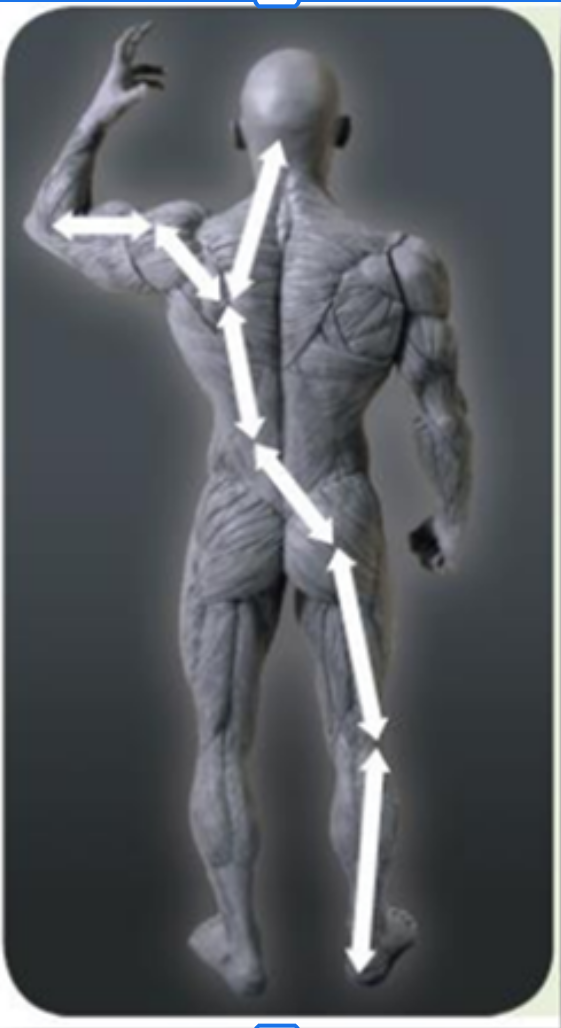
So this helps relieve the tissues of some of those forces from running.
Hip Circles
When should you seek further help?
If you start having sharp or shooting pains in your back or down your legs, then it would be time to seek further help. An assessment from your local athletic trainer, physical therapist or orthopedic doctor are all able to give you an evaluation to help determine the next steps needed to address your pain.
Need Help?
If you live in the South Bay and back stiffness keeps showing up after your runs, I’d be happy to help you understand why, and what your body needs to feel safe again.
For some runners, that starts with a comprehensive orthopedic assessment that looks at how your body is managing load, movement, and protection patterns, so we can determine the most appropriate next steps.
Learn more about my Orthopedic Assessment & Movement Evaluation